Synax
A local-first coding agent for quantized and open models.
Transparency beats magic when you're running AI on your own machine.
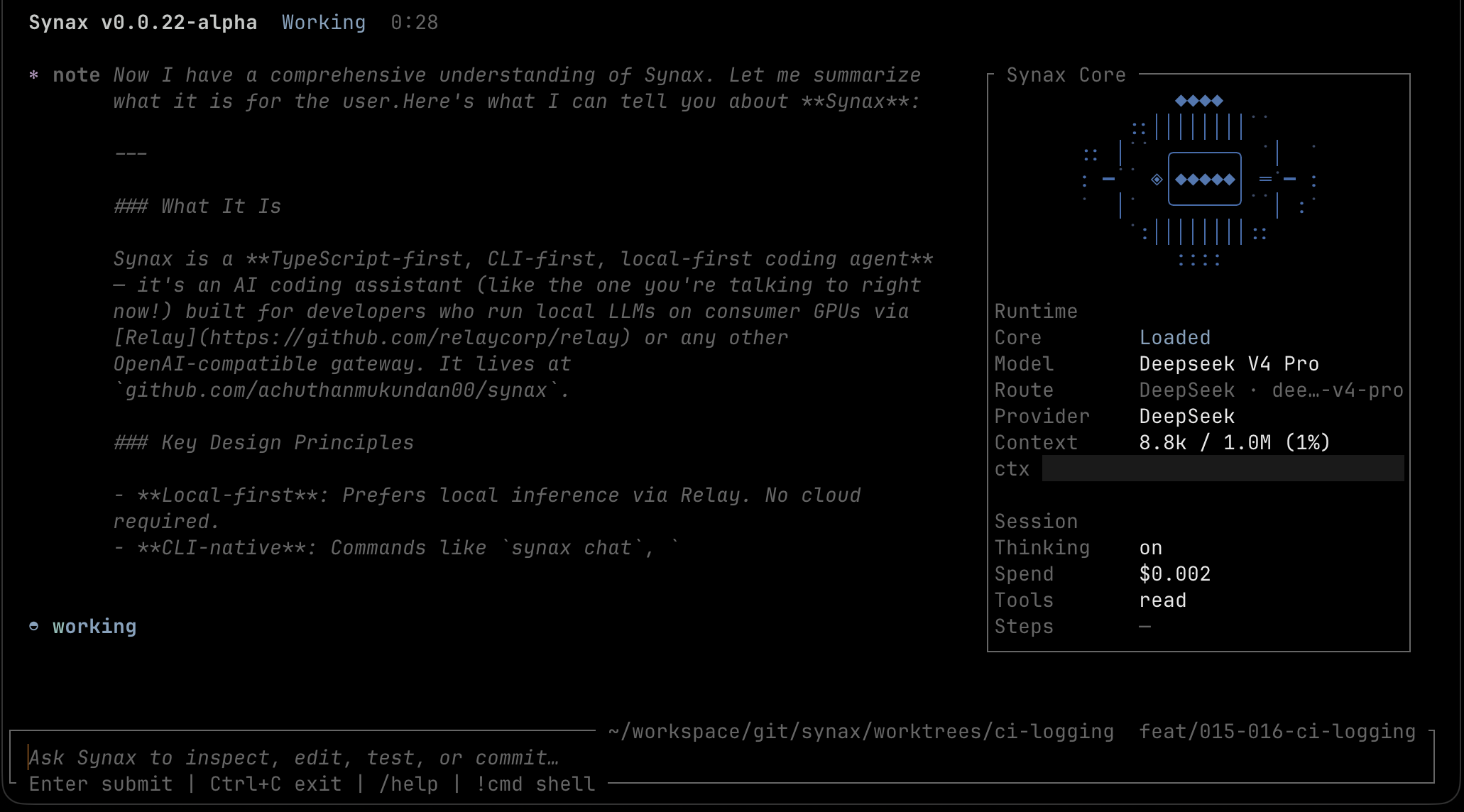
Terminal Preview
Problem
Most coding agents are built and tested against large cloud models with generous latency budgets and near-perfect instruction following. When those same agent architectures are run against quantized local models, the assumptions break: smaller models need different prompting strategies, produce different failure modes, and don't benefit from the latency headroom that hides cloud-agent slowness. The tooling gap between cloud-first agents and local-first development remains wide.
Solution
Synax is an experiment in making local models useful in real development loops. Instead of treating local inference as a degraded version of cloud inference, it builds the agent architecture around local-model constraints from the start: constrained output grammars, explicit verification steps, patient retry strategies, and a TUI designed for transparency rather than magic. The goal is not to be another cloud-first coding assistant — it is to explore what agent architecture looks like when the model is local, quantized, and imperfect-but-fast.
What I Built
I built Synax as a TypeScript agent runtime with a first-class TUI. The interface shows the current reasoning step, active tool calls, model response streaming, and execution logs — all organised in collapsible panels. A control surface lets developers pause, step through, or redirect the agent mid-loop. The backend uses a provider abstraction that normalises local model APIs and handles the quirks of quantized inference. The system is actively dogfooded in my own development workflow but is not yet ready for general use.
Technical & Product Focus
Experimental agent loop architecture with structured logging at every step. Terminal UI (TUI) with real-time streaming panels. Provider abstraction for local model APIs. TypeScript, Node.js. Quantified output grammars for reliable structured generation from quantized models. Active research into local-first agent UX patterns.
Links
Next Steps
Stabilize the agent loop and configuration system. Expand provider support for additional local model servers. Add agent checkpoints for rewind/replay. Continue dogfooding to identify failure modes and UX gaps before considering any broader release.